
Flood Insurance in Pigeon Forge, TN: What Every Homeowner and Cabin Owner Needs to Know
Pigeon Forge sits in the valley of the Little Pigeon River, where mountain runoff from the Great Smoky Mountains can turn a manageable stream into a dangerous flood in hours. This guide explains FEMA flood zones in Sevier County, what NFIP and private flood insurance cost, and why cabin and short-term rental owners face coverage gaps most standard policies will not fill.
Why Flood Risk in Pigeon Forge Is Different from Most of Tennessee
Flooding in most of Tennessee arrives gradually as rivers swell over days of sustained rain. In the Smoky Mountain foothills, the danger is far more sudden. Steep terrain above Pigeon Forge — the same ridgelines that make this corner of East Tennessee visually stunning — compresses rainfall into narrow creek channels at remarkable speed. What flows gently under the Parkway bridge on a sunny day can become a destructive torrent within an hour of a heavy thunderstorm upstream.
Three waterways define the flood geography of Sevier County. The West Prong of the Little Pigeon River drains Gatlinburg and the upper elevations of Great Smoky Mountains National Park before joining the main channel near Pigeon Forge. The Middle Prong collects runoff from the Wears Valley corridor. The combined Little Pigeon River then runs north through Pigeon Forge proper, collecting additional tributary flows before emptying into Douglas Lake near Sevierville. Any sustained rainfall across those upper watersheds puts properties along the valley floor at risk, regardless of what the sky looks like in downtown Pigeon Forge at the time.
According to First Street Foundation's climate risk data, 34.5 percent of properties in Pigeon Forge carry some risk of flooding today — well above the national average. First Street rates the city's overall community flood risk as Major, and calculates a 26 percent chance of at least one significant flood event affecting a given property over the life of a 30-year mortgage.
FEMA Flood Zones in Pigeon Forge and Sevier County
The Federal Emergency Management Agency publishes Flood Insurance Rate Maps (FIRMs) that divide land into risk zones. Understanding which zone your property sits in determines whether flood insurance is legally required, how much it will cost, and what building regulations apply.
Zone AE is the designation that matters most for properties along the Little Pigeon River corridor through Pigeon Forge. Zone AE is a Special Flood Hazard Area (SFHA) — FEMA's formal term for the 100-year floodplain, meaning an area with a 1 percent annual chance of flooding. Properties in Zone AE with federally backed mortgages (FHA, VA, USDA, conventional loans sold to Fannie Mae or Freddie Mac) are required by law to carry flood insurance. The 26 percent cumulative probability of flooding over a 30-year loan makes that mandate easy to understand — Zone AE is not a remote risk, it is a recurring reality.
Zone A (without the "E") appears on some older Sevier County map panels where a detailed engineering study has not yet established a precise Base Flood Elevation (BFE). Zone A properties also require mandatory flood insurance with federally backed mortgages, but the absence of a BFE makes elevation certificates harder to use for rating and means some homeowners pay more than they would in a mapped Zone AE.
Zone X (shaded) covers areas between the 100-year and 500-year floodplain boundaries. Flood insurance is not federally required in Zone X, but flooding absolutely occurs there — particularly the fast-moving flash floods that mountain creek systems are prone to produce. FEMA's own data shows that roughly 40 percent of all flood insurance claims come from properties outside SFHA designations.
To find the exact zone designation for a specific Pigeon Forge address, use the FEMA Flood Map Service Center or the Tennessee NFIP Mapping tool available through TEMA.
The City of Sevierville participates actively in the National Flood Insurance Program and maintains floodplain management regulations that meet FEMA federal standards, ensuring that residents, businesses, and property owners in Sevier County remain eligible for federally backed flood insurance.
Historical Flooding Along the Little Pigeon River
Flooding is not a theoretical risk in Sevier County — it is a documented, recurring event that has shaped the valley for generations.
The region's first recorded major flood occurred in 1875, when the Pigeon River crested at 19.5 feet in Sevierville. In August 1938, a severe flash flood on Webb Mountain sent a 10–12 foot wall of water through Sevierville, destroying everything in its path. The Tennessee Valley Authority began a flood channelization program on the West Prong in 1966 specifically to reduce the risk of recurrence in the lower valley.
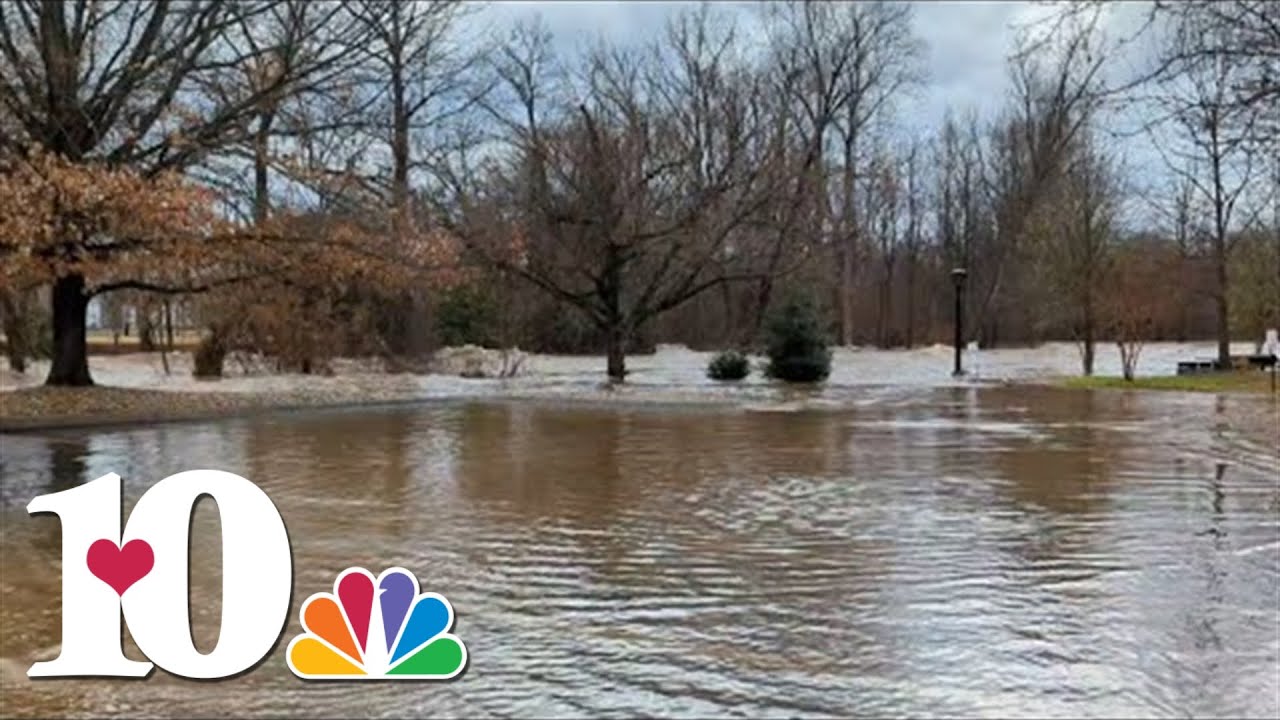
More recently, February 2019 brought historic rainfall to East Tennessee. The Little Pigeon River spilled far beyond its banks in Pigeon Forge and Gatlinburg, damaging businesses and residential properties along the Parkway corridor. Surveillance footage from that event — showing the river engulfing parking lots and reaching the lower floors of commercial properties — circulated widely online and illustrated just how quickly normal creek levels can become dangerous.
In September 2024, Hurricane Helene delivered historic rainfall across the southern Appalachians. While the Little Pigeon River stayed within its banks during Helene — in large part because the heaviest rainfall fell on the North Carolina side of the divide — the event was a stark reminder that a storm tracking slightly differently could have produced catastrophic results in the Pigeon Forge valley. Neighboring Cocke County received severe flooding, and Douglas Dam near Sevierville approached record pool levels as TVA managed runoff from the entire watershed.
The pattern is consistent: when the upper Smoky Mountain watersheds receive several inches of rain in a short period, properties along the Little Pigeon River system face serious risk. Tennessee averages 2,500 to 4,000 NFIP flood insurance claims per year statewide, with average claim payouts approaching $52,000 nationally. A single flood event can cause $50,000 to $200,000 in damage to a typical Tennessee home.
NFIP vs. Private Flood Insurance: A Rate Comparison for Pigeon Forge
Two main paths exist for purchasing flood insurance: a policy through the federal National Flood Insurance Program (NFIP), or a policy from one of approximately 80 private carriers now active in the flood insurance market.
The Tennessee statewide average NFIP premium is $1,153 per year according to Bankrate's analysis of FEMA data. That figure blends all zones and property types. In practice, what a Pigeon Forge homeowner actually pays depends heavily on which FEMA zone the property sits in, the home's elevation relative to the Base Flood Elevation, and the replacement cost of the structure.
| Flood Zone | Risk Level | NFIP Annual Premium | Private Annual Premium | Coverage Max (NFIP) | Flood Insurance Required? |
|---|---|---|---|---|---|
| Zone AE (on or near river) | High (100-year floodplain) | $1,500 – $4,000+ | $900 – $2,800 | $250K building / $100K contents | Yes, if federally backed mortgage |
| Zone A (unmapped BFE) | High | $1,200 – $3,500+ | $1,000 – $3,000 | $250K building / $100K contents | Yes, if federally backed mortgage |
| Zone X Shaded (moderate risk) | Moderate (100–500 year) | $700 – $1,500 | $400 – $900 | $250K building / $100K contents | No, but strongly recommended |
| Zone X Unshaded (low risk) | Low (outside 500-year) | $300 – $700 | $200 – $500 | $250K building / $100K contents | No |
Sources: FludZone (Zone AE data); Flood Insurance Guru; ASIG Tennessee Flood Guide. Premiums are estimates and vary by individual property characteristics.
The most significant structural difference between NFIP and private flood insurance is the coverage ceiling. NFIP caps building coverage at $250,000 — a figure that falls well short of the replacement cost for many Pigeon Forge properties. According to Redfin market data, the median home sale price in Pigeon Forge reached $736,000 in early 2026, reflecting the premium that short-term rental income potential adds to cabin and resort properties. An NFIP policy covering only $250,000 of structure on a $700,000 cabin leaves the owner deeply exposed. Private flood insurance can provide dwelling coverage up to $1 million or more, making it the stronger option for high-value properties.
Additional distinctions worth considering:
- Waiting periods: NFIP policies require a 30-day waiting period before coverage takes effect. Many private carriers offer 14-day or even immediate effective dates, which matters when a property purchase is under contract.
- Living expenses: NFIP does not cover additional living expenses if you must vacate your home after a flood. Private policies commonly include this benefit, which is particularly relevant for full-time Pigeon Forge residents.
- Policy stability: NFIP policies cannot be canceled mid-term as long as premiums are paid. Private carriers can non-renew or cancel coverage, a risk factor worth weighing for properties in higher-risk zones.
- Basement and contents coverage: NFIP has significant limitations on contents stored in basements. Private policies are typically broader.
Special Considerations for Short-Term Rental and Cabin Properties
Pigeon Forge is one of the most active short-term rental markets in the United States. Thousands of cabins and chalets operate as income-producing properties on platforms like Airbnb and VRBO throughout Sevier County. This commercial use fundamentally changes the insurance picture in two ways.
First, standard homeowners insurance does not cover properties used primarily as short-term rentals. A cabin generating rental income requires a landlord or commercial property policy — and flood insurance purchased separately, since neither landlord policies nor standard homeowners policies cover flood damage. The gap is not a technicality; it is a total exclusion. A flooded STR cabin without proper flood coverage leaves the owner paying reconstruction costs and lost rental income entirely out of pocket.
Second, the high assessed values of Sevier County cabin properties make the NFIP's $250,000 building limit particularly inadequate. A three-bedroom cabin earning $80,000 to $100,000 or more per year in rental income may have a replacement cost well above $400,000 when construction, finishes, and mechanical systems are included. Private flood insurance — with building limits that can reach $1 million or beyond — is frequently the more appropriate solution for these properties.
Buyers exploring the East Tennessee short-term rental market can find detailed market context and property insights through Kings of Real Estate (kingsofrealestate.com), which specializes in Smoky Mountain investment properties and has deep familiarity with the Sevier County cabin sector. Understanding a property's flood zone designation before closing is as important as knowing the rental income history.
Flash Flood Risk Beyond the Mapped Flood Zone
FEMA flood maps reflect a statistical model of river flooding based on historical data — they do not capture all the ways that mountain terrain creates flood risk. Properties well outside the mapped Zone AE in Pigeon Forge and the surrounding mountain communities can still experience damaging flash floods from two sources that FIRMs do not fully represent.
Mountain creek flash flooding occurs when intense localized thunderstorms dump several inches of rain on a small drainage basin in a short period. The runoff has nowhere to go except downhill at speed. Small tributary creeks that appear harmless on a FEMA map can briefly carry flows that overtop their banks, damage structures, wash out driveways, and deposit debris. This type of flooding is common across the Smoky Mountain foothills and is particularly dangerous because it arrives faster than any warning system can effectively communicate.
Post-wildfire flooding is an increasingly recognized risk in this region. The November 2016 Gatlinburg wildfires destroyed thousands of acres of forest on the slopes above the valley. Burned terrain loses its ability to absorb rainfall, dramatically increasing runoff rates. Properties near mountain streams throughout Sevier County should carry flood insurance regardless of their FEMA zone designation, precisely because the FIRM does not account for post-fire hydrological changes or the behavior of small unnamed drainages during extreme rainfall.
First Street Foundation estimates that 18 percent of all properties in Sevier County carry some flood risk under their model — a figure that exceeds what FEMA's maps would suggest, because First Street incorporates pluvial (rainfall-driven surface) flooding that FEMA does not map.
How Risk Rating 2.0 Changed NFIP Premiums in East Tennessee
FEMA fully implemented Risk Rating 2.0 in April 2023, replacing a decades-old pricing methodology that relied heavily on flood zone designations. Under Risk Rating 2.0, individual NFIP premiums are calculated based on 18 variables specific to each property, including its distance to the nearest water source, the frequency with which flooding is modeled to occur, first-floor height relative to the ground, foundation type, and the replacement cost of the structure.
The transition has produced uneven results across Tennessee. Some policyholders — particularly those in lower-risk zones who were previously overcharged relative to their actual flood exposure — saw premium decreases. Others in higher-risk zones closer to waterways saw significant increases. Federal law caps NFIP annual increases at 18 percent per year, but for properties whose actuarial rate is substantially above their current premium, that 18 percent cap means a series of annual increases stretching over several years.
The Tennessee NFIP average annual premium is $1,153 under the most recent FEMA data, placing the state near the national average of $926. For properties along the Little Pigeon River corridor in Zone AE, premiums that are below the actuarial rate will continue to increase at the 18 percent cap until they reach parity. This makes it especially important for Pigeon Forge homeowners to request an elevation certificate — a licensed surveyor's measurement of the structure's lowest floor height relative to the BFE — as even modest elevation above the BFE can significantly reduce an NFIP premium.
About All Seasons Insurance Group
All Seasons Insurance Group is an independent insurance agency headquartered in Sevierville, Tennessee, with additional offices in Knoxville. As an independent agency, All Seasons works with multiple insurance carriers rather than representing a single company — a structural advantage that allows the agency to compare NFIP options alongside private flood carriers, landlord policies, and short-term rental coverage in a single conversation.
The agency's focus on East Tennessee is not incidental. The team lives and works in the same communities they serve, which means they have direct familiarity with the flood zones along the Little Pigeon River, the elevation challenges of mountain cabin properties, and the coverage gaps that frequently affect Sevier County short-term rental owners. For homeowners, cabin investors, and STR operators in Pigeon Forge and the surrounding area seeking flood insurance guidance, All Seasons Insurance Group can be reached at (865) 263-1400 or online at asigtn.com. The Sevierville office is located at 1001 Parkway, Sevierville, TN 37862.
Frequently Asked Questions About Flood Insurance in Pigeon Forge
Is flood insurance required for homes in Pigeon Forge?
Flood insurance is federally required for properties in Special Flood Hazard Areas (Zones A and AE) that carry a federally backed mortgage. This includes most FHA, VA, USDA, and conventional loans sold to Fannie Mae or Freddie Mac. Properties in lower-risk Zone X are not required to carry flood insurance, but given that roughly 40 percent of all NFIP claims nationally come from outside high-risk zones, many Pigeon Forge homeowners choose to carry coverage voluntarily.
Does my homeowners insurance cover flood damage in Pigeon Forge?
No. Standard homeowners insurance policies explicitly exclude flood damage. This exclusion applies regardless of what caused the flooding — river overflow, flash flooding from mountain creek systems, or surface water accumulation during heavy rain. Flood coverage must be purchased separately, either through the NFIP or a private flood insurance carrier. This applies equally to landlord policies covering short-term rental cabins.
How much does flood insurance cost for a cabin or STR property near the Little Pigeon River?
Cost depends on the property's FEMA flood zone, its elevation relative to the Base Flood Elevation, and the replacement cost of the structure. For a Zone AE property along the Little Pigeon River corridor, NFIP premiums typically range from $1,500 to $4,000 or more per year. Private flood insurance for the same property may run $900 to $2,800 annually and can offer higher coverage limits — important for cabins with replacement costs above the NFIP's $250,000 building cap. Properties in lower-risk zones can often obtain coverage in the $300–$700 range.
Can I get flood insurance for a short-term rental cabin in Sevier County?
Yes, but the coverage structure is more complex than for an owner-occupied residence. A cabin operating as a short-term rental needs a landlord or commercial property policy as its primary coverage, with flood insurance purchased as a separate policy — either through the NFIP or a private carrier. The NFIP's $250,000 building limit is frequently insufficient for high-value Smoky Mountain cabins, making private flood insurance or an excess flood policy worth evaluating. An independent agent who understands the Sevier County STR market can help identify which combination of policies closes the coverage gaps.
What is the waiting period for flood insurance in Pigeon Forge?
NFIP policies have a standard 30-day waiting period from the date of purchase before coverage becomes effective. This means flood insurance cannot be purchased when a storm is already forming and expected to cause flooding. The 30-day waiting period does not apply in a few specific situations, including purchase tied to a loan closing or a map revision that places a property into a higher-risk zone. Private flood carriers frequently offer shorter waiting periods — some as few as 10 to 14 days — which can be an advantage during a real estate transaction closing on a tight timeline.
About the Author
All Seasons Insurance Group is a locally owned, independent insurance agency proudly serving Tennessee families and businesses since 2021. Founded by Tannor Giles and Preston Stewart, our licensed team is committed to finding the best coverage at competitive rates — because as an independent agency, we shop multiple carriers on your behalf to get you the right policy, not just the cheapest one.
With offices in Sevierville (1001 Parkway) and Knoxville (121 Suburban Rd), we specialize in home, auto, business, farm, renters, and investment property insurance across East Tennessee — from the Smoky Mountains to Nashville.
Ready to review your coverage? Call us at (865) 263-1400 or get a free quote online.
Seasons change. So should your coverage.