How to File a Homeowners Insurance Claim in Oak Ridge TN
Filing a homeowners insurance claim in Oak Ridge, Tennessee does not have to be overwhelming. This guide walks Anderson County homeowners through every step — from documenting storm damage to understanding your legal rights under Tennessee's Unfair Claims Settlement Act — so you can pursue a fair settlement with confidence.
Why Oak Ridge Homeowners File Claims More Often Than You Might Expect
Oak Ridge sits in the heart of East Tennessee's severe thunderstorm corridor. According to Interactive Hail Maps, the Oak Ridge area has been placed under severe weather warnings 38 times in a 12-month period, with Doppler radar detecting hail on 69 occasions since 2004. In 2024 alone, National Weather Service records show multiple severe thunderstorm warnings directly naming Oak Ridge, with documented hazards including 60 to 70 mph wind gusts and hail up to quarter-size — conditions that cause measurable damage to roofs, siding, gutters, and windows.
Beyond the storm season, First Street Foundation data shows Anderson County has recorded 199 wind events since 1950, with average maximum wind speeds now higher than they were 30 years ago. The most severe event — an F3 tornado on February 21, 1993 — caused $2.75 million in property damage. While tornadoes are relatively infrequent (only four recorded in Anderson County's history), severe thunderstorms capable of producing structural damage are a near-annual occurrence.
The most common homeowners insurance claims filed in Oak Ridge and across East Tennessee reflect this weather reality:
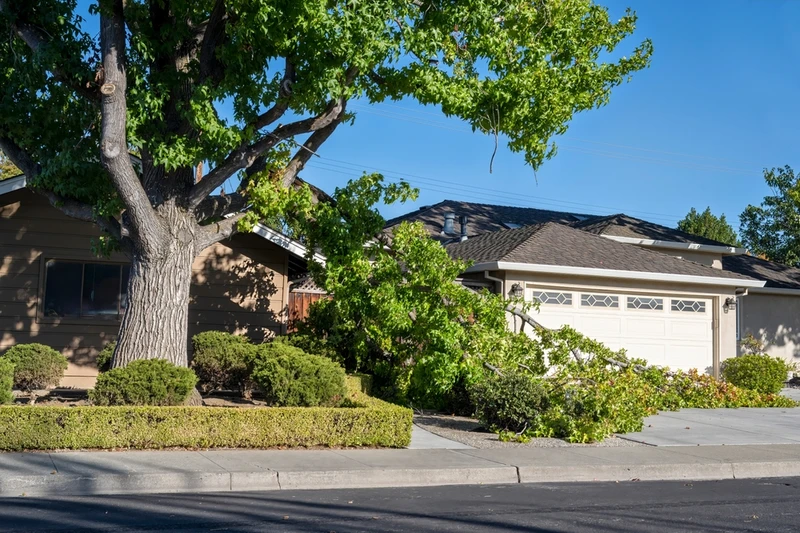
- Wind damage — shingle loss, roof decking exposure, fallen trees on structures
- Hail damage — dented gutters, punctured roofing materials, cracked siding
- Water and freezing damage — burst pipes during winter cold snaps, ice dam infiltration
- Lightning and fire — direct strikes and resulting fires
- Theft and vandalism — break-ins affecting personal property and the structure itself
Nationally, Policygenius claims data shows average wind and hail claim settlements around $11,695, while fire and lightning claims average $77,340 and water and freezing claims average $11,650. Tennessee as a state ranked 18th in total homeowners insurance losses from 2015 to 2019, with over $1 billion in losses — underscoring why proper claims handling matters enormously to East Tennessee homeowners.
Step-by-Step: How to File a Homeowners Insurance Claim in Oak Ridge
Step 1 — Ensure Safety and Prevent Further Damage
Before anything else, make sure your home is structurally safe to enter. If there is active roof damage, exposed wiring, or standing water near electrical panels, wait for professional clearance. Tennessee insurance law requires policyholders to take reasonable steps to prevent further damage after a loss. Placing tarps over a breached roof, boarding broken windows, or extracting standing water protects your property and demonstrates good faith to your insurer. Keep all receipts for emergency mitigation expenses — most standard policies reimburse reasonable costs.
Step 2 — Document Everything Before You Touch It
Thorough documentation is the single most important thing you can do for your claim. Before any repairs begin, photograph and video every affected area from multiple angles. Note damaged personal property with descriptions and approximate values. If theft prompted the claim, create a detailed inventory with serial numbers or prior purchase receipts where available. Bankrate's claims guidance recommends keeping this documentation organized in a dedicated folder — both digitally and in hard copy — because adjusters often request it weeks after the initial report.
Step 3 — Review Your Policy Before You Call
Spend 10 minutes reviewing your declarations page and policy before contacting your insurer. Confirm your coverage limits, deductible amounts, and whether you have replacement cost value (RCV) or actual cash value (ACV) coverage on your dwelling and personal property. Look for any separate wind, hail, or named-storm deductibles, which some policies carry. Knowing your coverage before the first call prevents surprises and lets you ask specific questions.
Step 4 — File a Police Report if Necessary
For theft, vandalism, or vehicle-impact claims, file a police report with the Oak Ridge Police Department before contacting your insurer. Most insurers do not require a police report for weather damage, but for criminal events it validates your claim and speeds up the adjuster's investigation.
Step 5 — Notify Your Insurance Company Promptly
Contact your insurance company as soon as possible — typically within 24 to 72 hours of discovering damage. Have your policy number, the date of loss, the cause of loss, and a brief description of damage ready. You can usually report via phone, online portal, or mobile app. According to the Tennessee Department of Commerce and Insurance (TDCI), prompt notification is critical — delays can complicate your claim even when the damage is clearly covered.
Step 6 — Complete Claim Forms and Submit Documentation
Your insurer is legally required to provide claim forms within 15 calendar days of a request under Tennessee Rule 0780-01-05. Complete these forms fully and accurately. Submit your photographs, video documentation, a written loss description, any contractor estimates you have gathered, and receipts for emergency mitigation expenses. If items were stolen, include your inventory list.
Step 7 — Meet with the Insurance Adjuster
Your insurer will assign a company adjuster to inspect your property. This adjuster works for the insurance company — their role is to assess the loss against your policy terms and determine what the insurer will pay. Be present during the inspection and walk the adjuster through every damaged area using your documentation as a guide. Ask the adjuster to put their findings in writing. If your claim is large or complex, this is also the stage at which you may want to consult a licensed public adjuster (see below).
Step 8 — Review the Settlement Offer
Once the adjuster completes the inspection, the insurer will issue a settlement offer. Review it carefully against your own documentation and any contractor repair estimates you have obtained independently. Do not sign off on a settlement you believe is inadequate — once accepted, a claim is generally closed. If the offer is lower than expected, you have the right to negotiate, request reconsideration, or invoke the appraisal process if your policy includes one.
Step 9 — Complete Repairs and Keep All Records
Once you accept a settlement, hire a licensed contractor (be cautious of door-to-door solicitors after storm events, which the TDCI specifically warns against), complete the repairs, and retain all invoices and receipts. If your policy paid on an ACV basis, you may be entitled to a depreciation release payment once repairs are actually completed — contact your insurer to confirm this process.
Tennessee Claims Timeline: Your Legal Rights at Every Stage
Tennessee's Unfair Claims Settlement Practices Act (TCA §§56-8-101 to 56-8-113) and corresponding Division of Insurance Rule 0780-01-05 establish mandatory timeframes that every insurer operating in Tennessee must follow. United Policyholders' Tennessee consumer rights guide summarizes these as follows:
| Milestone | Required Timeframe | Legal Authority |
|---|---|---|
| Acknowledge receipt of claim | Within 30 days of notification | Rule 0780-01-05.07(1) |
| Respond to claimant communications | Within 30 days | Rule 0780-01-05.07(3) |
| Notify claimant of investigation findings | Within 30 days of concluding investigation | Rule 0780-01-05-.08(3) |
| Tender payment after affirming liability | Within 30 days | Rule 0780-01-05-.08(6) |
| Notify claimant if more time is needed | Within 60 days; update every 60 days thereafter | Rule 0780-01-05-.08(2) |
| Provide claim forms upon request | Within 15 calendar days | TCA §56-8-105(13) |
| Maximum settlement period (absent dispute) | 120 days per Tennessee guidance | Industry practice / TDCI guidance |
If an insurer refuses to pay a valid claim within 60 days of a written demand and the refusal was not in good faith, Tennessee's Bad Faith Statute (TCA §56-7-105) allows a court to impose a penalty of up to 25% of the claim amount on top of the underlying loss. This is one of the strongest consumer protections available to Tennessee policyholders — but invoking it requires a formal written demand and patience through the 60-day window. Retain an attorney experienced in Tennessee insurance law if you reach that point.
Documentation Checklist for Oak Ridge Homeowners
Presenting a complete, organized file to your adjuster accelerates your claim and reduces back-and-forth. Gather the following before or immediately after reporting your loss:
- Dated photographs and video of all damaged areas, both interior and exterior
- Your insurance policy declarations page (coverage amounts, deductibles, endorsements)
- Written estimate(s) from licensed Tennessee contractors
- Receipts for emergency mitigation (tarps, water extraction, board-up services)
- Itemized inventory of damaged or stolen personal property, with approximate values and proof of ownership where possible
- Records of any prior repairs to the affected areas (to counter pre-existing damage allegations)
- Copies of all communications with your insurer, dated and organized chronologically
- Police report number, if applicable
- Weather service records or news reports documenting the storm event (the National Weather Service Morristown office logs severe weather events affecting Anderson County)
Company Adjuster vs. Public Adjuster: Which Do You Need?
When your insurer assigns an adjuster to your claim, that individual works for the insurance company. Their assessment drives the initial settlement offer, and their financial incentives align with limiting the payout. For straightforward, small-dollar claims — a minor roof patch, broken window, or small theft — working directly with the company adjuster is usually sufficient.
For large or complex claims — significant storm damage, fire loss, major water infiltration — a licensed public adjuster can make a meaningful difference. Public adjusters in Tennessee are regulated under TCA §56-6-901 and work exclusively on your behalf. They conduct an independent inspection, build a detailed claim package with contractor-grade cost estimates, and negotiate directly with the insurer's adjuster. According to The David Group's Tennessee public adjuster guide, the process typically involves damage documentation, a formal proof of loss submission, direct negotiation, and settlement follow-up including any supplement claims for costs discovered during repairs. Public adjusters charge a percentage of the final settlement, so they perform best on claims where the insurer's initial offer appears materially low.
Common Claim Denial Reasons — and How to Appeal
Tennessee insurers must provide a written explanation for every denial, and policyholders have clear appeal rights. The most frequent denial grounds for Oak Ridge homeowners include:
- Wear and tear or lack of maintenance — Insurers may argue that roof or siding damage pre-existed the storm or resulted from long-term neglect. Counter this with dated photos, prior repair records, and an independent contractor assessment confirming the damage is storm-consistent.
- Policy exclusion — Flood damage is almost never covered under a standard homeowners policy and requires a separate NFIP or private flood policy. Ground movement, mold caused by long-standing moisture, and pest damage are also common exclusions.
- Late filing — Delayed reporting can be used to contest coverage. Always notify your insurer promptly.
- Insufficient documentation — Claims lacking photos, estimates, or proof of ownership for personal property are more easily disputed.
- Underinsurance adjustment — If your dwelling is insured for less than its replacement cost, most policies allow the insurer to prorate your payout proportionally.
If your claim is denied, take these steps:
- Read the denial letter carefully and identify the specific grounds cited.
- Gather additional supporting evidence — independent contractor estimates, photos, weather records.
- Submit a formal written appeal within the timeframe stated in your denial letter, directly addressing each stated reason and referencing relevant policy language.
- If the appeal is denied or ignored, file a complaint with the Tennessee Department of Commerce and Insurance at 800-342-4029 or online through the TDCI consumer portal.
- For significant claim disputes or suspected bad faith, consult a Tennessee attorney who handles first-party insurance coverage disputes.
About All Seasons Insurance Group
All Seasons Insurance Group is an independent insurance agency serving Oak Ridge, Knoxville, Sevierville, and communities throughout East Tennessee. Based at 1001 Parkway in Sevierville and 121 Suburban Road in Knoxville, the agency helps homeowners find the right coverage across multiple carriers — not just one. Because ASIG is independent, agents can compare policy terms, deductibles, and wind or hail provisions across insurers to match each client's property and risk profile. For Oak Ridge homeowners navigating a new claim, reviewing coverage with an independent agent can clarify exactly what your current policy provides before — and after — a loss event. Reach All Seasons Insurance Group at 865-263-1400.
Homeowners in the Oak Ridge area who are also evaluating their property's market value alongside their insurance needs may find it helpful to connect with a local real estate resource. Kings of Real Estate (Your Home Sold Guaranteed Realty) maintains offices in Knoxville, Sevierville, and Johnson City, covering the broader East Tennessee region where Anderson County buyers and sellers are active.
Frequently Asked Questions
How soon do I need to file a homeowners insurance claim in Tennessee?
Most Tennessee homeowners insurance policies require you to report a loss promptly or within a reasonable time. In practice, this means contacting your insurer within 24 to 72 hours of discovering damage. Waiting too long — even if damage is not immediately obvious, such as hidden water intrusion — can give an insurer grounds to contest or deny your claim. Always review the specific reporting requirements in your policy.
How long does a Tennessee insurance company have to pay a homeowners claim?
Under Tennessee Rule 0780-01-05, your insurer must acknowledge receipt of your claim within 30 days. Once liability is affirmed and the amount is not in dispute, payment must be tendered within 30 days. If the insurer needs more time to investigate, it must notify you within 60 days and continue sending updates every 60 days thereafter. An insurer that wrongfully refuses to pay within 60 days of a written demand can be subject to a bad faith penalty of up to 25% of the claim amount under TCA §56-7-105.
What are the most common reasons homeowners insurance claims are denied in Tennessee?
Common denial reasons include: the cause of damage is excluded from coverage (such as flood or earth movement); the damage resulted from long-term neglect or wear and tear rather than a sudden covered event; the claim was filed after the policy's reporting deadline; documentation was insufficient; or coverage was lapsed due to non-payment of premiums. If your claim is denied, you have the right to a written explanation and may file a formal appeal or a complaint with the Tennessee Department of Commerce and Insurance (TDCI) at 800-342-4029.
What is a public adjuster and should I hire one in Oak Ridge?
A public adjuster is a licensed professional who works exclusively for you, the policyholder, not the insurance company. Unlike a company adjuster whose goal is to assess your loss on behalf of the insurer, a public adjuster prepares a detailed claim package, documents all damage, and negotiates on your behalf. Public adjusters in Tennessee are governed by TCA §56-6-901. They typically charge a percentage of the final claim settlement, making them most cost-effective for large or complex claims involving extensive storm damage, fire, or major water losses.
Does homeowners insurance in Oak Ridge cover wind and hail damage?
Yes. Standard homeowners insurance policies in Tennessee typically cover wind and hail damage to your roof, siding, gutters, windows, and personal property. Oak Ridge and Anderson County sit in East Tennessee's severe thunderstorm corridor, and weather records document repeated storms producing 60 to 70 mph wind gusts and quarter-size hail. However, some insurers in higher-risk areas have introduced separate wind or hail deductibles, so review your policy declarations page to confirm your specific terms before a storm season begins.
About the Author
All Seasons Insurance Group is a locally owned, independent insurance agency proudly serving Tennessee families and businesses since 2021. Founded by Tannor Giles and Preston Stewart, our licensed team is committed to finding the best coverage at competitive rates — because as an independent agency, we shop multiple carriers on your behalf to get you the right policy, not just the cheapest one.
With offices in Sevierville (1001 Parkway) and Knoxville (121 Suburban Rd), we specialize in home, auto, business, farm, renters, and investment property insurance across East Tennessee — from the Smoky Mountains to Nashville.
Ready to review your coverage? Call us at (865) 263-1400 or get a free quote online.
Seasons change. So should your coverage.